


Market Overview
According to Market Research Future® (MRFR), the US Polymer Dispersion Market is projected to grow steadily from 2025 to 2035, supported by rising interest in eco-friendly materials, advances in manufacturing processes, and demand for specialized products across industrial applications. Polymer dispersions are used in formulations that require properties such as adhesion, flexibility, film formation, and surface protection. Their applications across adhesives and sealants, decorative and protective coatings, automotive products, consumer goods, packaging, and paints give the market exposure to several areas of manufacturing and materials development.
Market growth is shaped by evolving customer expectations and the need for products that combine reliable performance with environmental considerations. Manufacturers are working to improve formulation characteristics and production efficiency while responding to application-specific requirements. As end-use industries seek materials that meet performance targets and adapt to changing product designs, polymer dispersion suppliers have opportunities to develop differentiated offerings.
Market Size Reached in 2025
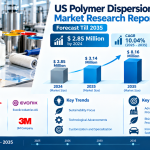
The US Polymer Dispersion Market reached $3.14 million in 2025, compared with a reported market size of $2.85 million in 2024. This provides the starting point for the forecast period and reflects demand across resin types, applications, and end-use industries. The market includes polyurethane and acrylic resin types, each of which can serve different formulation requirements depending on the intended application and desired performance characteristics.
Adhesives and sealants represent one application area, where polymer dispersions can support bonding and sealing formulations. Decorative and protective coatings represent another, serving surface-finishing and protection needs in residential, commercial, and industrial settings. End-use demand also comes from automotive, consumer goods, packaging, and paints. These sectors have varied technical and commercial requirements, making flexibility in product development important for suppliers.
The diversity of applications means that market performance depends on multiple demand sources. Changes in coatings requirements may influence one segment, while automotive manufacturing or packaging applications may create opportunities in another. Suppliers that understand these differences can better align product development and customer support with market needs.
Expected Market Size by 2035
The market is forecast to reach $8.16 million by 2035, reflecting a significant increase over the 2025 level. This outlook creates potential opportunities for raw-material suppliers, polymer dispersion producers, formulators, and downstream manufacturers. Future expansion will depend on demand from established applications, the commercial adoption of improved formulations, and the ability of producers to deliver products that meet increasingly specific requirements.
The projected growth also highlights the importance of manufacturing capabilities. Producers may need to improve process consistency, manage production costs, and support customers requiring tailored product properties. In applications such as coatings and adhesives, formulation performance can influence product durability, ease of application, and compatibility with manufacturing or installation processes. Technical service and dependable product quality may therefore remain important competitive factors.
Market CAGR
The US Polymer Dispersion Market is expected to register a CAGR of 10.04% from 2025 to 2035. This projected growth reflects the potential impact of sustainability priorities, technological advancements, and customization across end-use industries. While the market’s expansion may differ by resin type and application, the forecast suggests increasing opportunities for suppliers that respond effectively to product performance requirements and evolving customer preferences.
Polyurethane and acrylic dispersions can serve distinct needs depending on formulation design and application conditions. Likewise, adhesives and sealants may require different characteristics from decorative or protective coatings. This variety creates opportunities for targeted innovation rather than relying solely on broad, standardized products. Companies that align formulation capabilities with specific customer demands may be better placed to participate in market development.
Key Growth Drivers
Demand for eco-friendly products is an important factor shaping the market. Manufacturers and end users are increasingly evaluating materials based on performance as well as environmental considerations. Polymer dispersions that help formulators develop products aligned with sustainability objectives may gain attention, particularly in coatings and adhesives. The commercial potential of these solutions depends on their ability to meet application requirements, remain cost-competitive, and integrate with existing production processes.
Advancements in manufacturing processes offer another source of growth. Improvements in production controls, formulation techniques, and quality management can help manufacturers deliver more consistent products and respond to changing customer specifications. Better process efficiency may also support cost management and reduce production variability. For suppliers, continued investment in manufacturing capabilities can help strengthen their position in applications where consistency and reliability are essential.
The automotive sector provides additional opportunities for polymer dispersion suppliers. Automotive-related applications can require materials suitable for coatings, bonding, and other specialized functions. As manufacturers evaluate materials for performance, durability, and production compatibility, demand may develop for tailored dispersion technologies. Growth in this area will depend on application requirements and the adoption of suitable formulations by downstream customers.
Emerging Market Trends
Customization and specialization are becoming increasingly relevant as customers seek materials designed for specific operating conditions and performance targets. Coatings manufacturers, adhesive formulators, and industrial users may require variations in properties such as adhesion, flexibility, durability, and film formation. Suppliers that offer technical collaboration and application-focused development can address these requirements more effectively.
Sustainability is another defining trend. The opportunity is not limited to introducing new products; it also involves improving manufacturing processes and helping customers evaluate materials against their environmental and performance goals. Successful adoption requires a practical balance between environmental objectives, product functionality, processing requirements, and cost.
Competitive Landscape
Key companies identified in the US Polymer Dispersion Market include BASF SE, Dow Inc., Evonik Industries AG, Wacker Chemie AG, SABIC, and 3M Company. Competition can be influenced by formulation expertise, product consistency, manufacturing efficiency, customer relationships, and the ability to develop materials for specialized applications.
As the market develops, manufacturers may differentiate themselves through process improvements, customized solutions, and products that address demand for eco-friendly materials. The ability to serve coatings, adhesives, automotive, consumer goods, and packaging customers with application-appropriate products may support long-term competitiveness. Overall, the projected growth creates opportunities for suppliers that combine technical innovation with reliable manufacturing and an understanding of evolving end-user needs.