


Market Overview
According to Market Research Future® (MRFR), the Specialty Lubricants Market is expected to grow steadily during the 2025–2035 forecast period as industrial users seek lubrication products designed for specific operating conditions and performance requirements. Specialty lubricants support machinery, vehicles, manufacturing equipment, energy systems, and other applications where reducing friction, managing wear, and protecting components are essential. Their value comes from matching formulation and performance characteristics to the technical demands of each application.
The market spans automotive and transportation, industrial machinery, energy and power generation, metalworking and manufacturing, aerospace and defense, pharmaceuticals and healthcare, food and beverage, and marine and offshore applications. Products are differentiated by base oil type, additive technology, physical form, and performance characteristics. These segments reflect the range of conditions specialty lubricants must address, from high temperatures and heavy loads to corrosion exposure and requirements for water resistance or biodegradability.
Market Size Reached in 2025
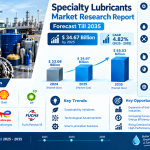
The specialty lubricants market was valued at $33.08 billion in 2024 and is projected to reach $34.67 billion in 2025. This increase provides the baseline for the industry's forecast-period expansion. Specialty lubricants serve applications where lubricant performance can affect equipment reliability, maintenance schedules, energy consumption, and operating efficiency.
Base oil selection is an important part of product formulation. The market includes mineral oils, synthetic oils, and bio-based oils, each serving different performance, operational, and application requirements. The appropriate choice depends on factors such as equipment design, operating conditions, lubricant specifications, and customer priorities. Additives further influence performance by supporting wear protection, friction reduction, resistance to extreme pressure, oxidation control, corrosion prevention, and cleanliness.
Specialty lubricants are also supplied in different forms, including oils, greases, pastes, and sprays. These formats serve different equipment designs and application methods. The variety of available formulations and forms allows suppliers to address a broad range of industrial and commercial requirements.
Expected Market Size by 2035
MRFR projects that the specialty lubricants market will reach $55.53 billion by 2035. This forecast reflects continuing demand for lubricants that help maintain equipment performance and support increasingly specialized operating requirements across end-user industries.
Industrial machinery and metalworking operations require lubrication solutions suited to their equipment, workloads, and production environments. Appropriate lubricants can help control friction and wear, protect components, and support reliable operation. As industrial users assess maintenance practices and operating efficiency, product selection becomes an important part of equipment management.
Automotive and transportation applications represent another significant area of demand. Vehicles and transport systems depend on lubrication to protect moving components and maintain performance under varying conditions. Specialty formulations may be selected where conventional products do not adequately meet application requirements.
Energy and power generation, aerospace and defense, marine and offshore operations, and healthcare-related applications create additional demand for products with specific performance characteristics. High-temperature stability, corrosion resistance, water resistance, and wear resistance can be especially relevant depending on the operating environment. The report's inclusion of food and beverage applications also highlights the diversity of industries served by specialty lubricants.
Market CAGR
The specialty lubricants market is forecast to register a compound annual growth rate (CAGR) of 4.82% from 2025 to 2035. This projected growth reflects continued demand for application-specific lubrication and ongoing attention to equipment reliability, operating efficiency, and product performance.
Market development will depend on industrial activity, customer requirements, advances in formulation and application technology, and the ability of manufacturers to provide products suited to different operating environments. Sustainability initiatives and smart lubrication solutions may also influence product development and purchasing decisions.
Key Growth Drivers
Expansion across end-user industries is a central opportunity for specialty lubricant suppliers. Manufacturing, transportation, energy, marine operations, and other sectors use equipment that requires suitable lubrication to operate effectively. As applications and operating conditions differ, customers may seek formulations designed for particular loads, temperatures, materials, or environmental exposures.
Energy efficiency is another important growth opportunity. Friction within machinery can contribute to energy losses and wear, making lubricant performance relevant to operational efficiency. Products designed to reduce friction or support smoother equipment operation may attract attention from organizations seeking to manage operating costs. Results depend on the equipment, lubricant formulation, maintenance practices, and application conditions.
Demand for high-performance lubricants also supports market development. Industrial users may need products that maintain stability under demanding temperatures, resist water exposure, limit corrosion, or protect components from wear. Specialty formulations can help address these needs when matched appropriately to the operating environment.
Emerging Market Trends
Sustainability initiatives are influencing the specialty lubricants industry as manufacturers and customers examine product life cycles, resource use, and environmental performance. Bio-based oils and biodegradable formulations are relevant to this discussion, particularly where environmental exposure or application requirements make such characteristics desirable. Suitability depends on technical performance, operating conditions, and the needs of the end user.
Technological advancements are another important trend. Developments in base oils, additives, and formulation methods can help suppliers tailor products to specific applications. Manufacturers must balance performance characteristics with reliability, compatibility, and cost.
Smart lubrication solutions represent an additional area of interest. Monitoring and data-supported maintenance practices can help operators understand equipment condition and plan lubricant use more effectively. The benefits depend on the quality of the information collected, the equipment being monitored, and how maintenance teams use that information.
Competitive Landscape
Key players identified in the report include ExxonMobil, Shell, BP, Chevron, TotalEnergies, and Fuchs Petrolub SE. These companies operate in a market where product formulation, performance consistency, technical support, and relationships with industrial customers can influence competitive positioning.
The competitive landscape spans multiple applications, base oil categories, additive technologies, and lubricant forms. Suppliers must understand the needs of customers in sectors ranging from automotive and manufacturing to energy, aerospace, healthcare, and marine operations. A product suited to one application may not be appropriate for another, making technical expertise and application-specific solutions important.
Looking ahead, sustainability, technological advancement, smart lubrication, and demand for high-performance products will shape opportunities across the forecast period. With the market projected to reach $55.53 billion by 2035, suppliers that align product development with customer requirements and operating efficiency goals may be positioned to pursue continued growth.