

Market Overview
According to Market Research Future® (MRFR), the India Iron Steel Market is positioned for significant expansion as the country continues to develop its infrastructure, manufacturing capabilities, transportation networks, and industrial base. Iron and steel are essential materials for construction, bridges, railways, automobiles, machinery, energy infrastructure, and a wide range of consumer and industrial products. Their importance across multiple sectors makes steel demand closely connected to investment activity, industrial production, and the development of public infrastructure.
India's steel industry serves diverse customers, from large infrastructure developers and automotive manufacturers to machinery producers and energy companies. The market encompasses crude steel and finished steel, produced through different technologies depending on raw-material availability, plant configuration, energy requirements, and product specifications. As end-user industries evolve, producers must balance capacity utilization, cost efficiency, product quality, and environmental performance.
Government-led infrastructure initiatives, industrial policy measures, and the expansion of electric-arc-furnace capacity are among the trends influencing the market's outlook. At the same time, emerging opportunities in green hydrogen-based direct reduced iron, digital steel trading platforms, and specialized grades for defence and shipbuilding could shape future investment priorities. The combination of established steel demand and evolving production technologies provides a foundation for continued market development.
Market Size Reached in 2025
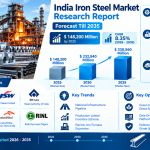
The India Iron Steel Market was valued at USD 148,200 million in 2025. This market size reflects the importance of iron and steel across India's construction, transportation, manufacturing, and energy-related activities. Demand is supported by the need for structural steel, reinforcing materials, industrial components, automotive products, and equipment used in commercial and public infrastructure.
Building and construction is an important end-user industry because steel is widely used in residential and commercial structures, industrial facilities, transport infrastructure, and engineering projects. Automotive and transportation manufacturers also rely on steel for vehicle bodies, structural components, and other applications where strength, durability, and manufacturing performance are important. Tools and machinery, energy, consumer goods, and other industries add further demand across the value chain.
Market development also depends on the mix of crude and finished steel production. Crude steel is an intermediate output that undergoes additional processing before becoming finished products suitable for specific uses. Finished steel includes products that can be supplied to construction companies, manufacturers, fabricators, and other customers. Producers must align output with changing demand across these applications while managing production costs and delivery schedules.
Expected Market Size by 2035
The market is projected to reach USD 330,560 million by 2035, indicating substantial anticipated growth over the forecast period. This outlook is consistent with the importance of steel in infrastructure development and industrial expansion. As projects require materials for buildings, transport systems, energy assets, and manufacturing facilities, demand for different steel products may increase alongside investment activity.
Infrastructure spending can support demand for reinforcing steel, structural sections, plates, and other products used in large construction projects. Expansion in transportation and automotive manufacturing may create additional requirements for steel with specific mechanical and manufacturing characteristics. Machinery, consumer goods, and energy applications contribute further opportunities, although product requirements differ by industry.
Achieving the projected market expansion will depend on several factors, including domestic demand, production capacity, technology investments, raw-material availability, and operating efficiency. Producers may need to adapt capacity and product portfolios as customer expectations evolve. Long-term competitiveness will also depend on how effectively the industry addresses environmental requirements while maintaining dependable supplies for India's industrial and infrastructure needs.
Market CAGR
The India Iron Steel Market is forecast to register a compound annual growth rate (CAGR) of 8.35% during the 2026–2035 period. This anticipated growth rate reflects the potential for sustained expansion as infrastructure, manufacturing, and energy-related activities support demand for iron and steel products.
The forecast also highlights the importance of production technology. The market includes Blast Furnace–Basic Oxygen Furnace (BF-BOF), Electric Arc Furnace (EAF), and other technologies, including induction furnace (IF) and direct reduced iron (DRI)-based processes. Each approach has different operational characteristics, material inputs, and production requirements. Producers select technologies based on their operating models, product needs, available resources, and investment strategies.
Growth may not be uniform across every end-use industry or production route. Construction activity, vehicle manufacturing, machinery demand, and energy investment can change at different rates. Steelmakers must therefore monitor demand patterns, manage production planning, and invest in capabilities that match the requirements of their target markets.
Key Growth Drivers
Infrastructure development is a major driver of India's steel demand. Roads, railways, industrial facilities, buildings, and other infrastructure projects require significant quantities of steel. The National Infrastructure Pipeline is an important policy framework associated with infrastructure investment and can support demand across construction and related supply chains. The timing and scale of individual projects influence when and where steel requirements materialize.
Industrial growth provides another source of demand. Automotive and transportation manufacturers use steel across vehicle structures and components, while tools and machinery producers depend on metal inputs for equipment and industrial systems. Growth in manufacturing can increase demand for steel products that meet specific requirements for strength, formability, durability, and dimensional consistency.
Energy infrastructure also contributes to market demand. Power facilities and associated infrastructure require steel products suited to their operating environments. Consumer goods and other industrial applications add further demand, creating a diverse customer base for producers.
Government policy initiatives, including the Production Linked Incentive Scheme, form another part of the market's development context. Such initiatives are intended to support industrial capabilities in designated sectors, although their direct effect on steel demand depends on the industries and projects involved. Together, infrastructure investment, industrial production, and policy measures create a supportive context for the market's forecast growth.
Emerging Market Trends
Electric-arc-furnace expansion is an important trend in steelmaking. EAF production offers a different production route from the traditional BF-BOF approach and can use scrap or direct reduced iron as metallic inputs, depending on the operating configuration. Its adoption depends on factors such as electricity availability, input-material supply, capital costs, and product requirements. As producers assess their long-term capacity plans, EAF technology may form part of broader modernization strategies.
Green hydrogen-based direct reduced iron is another emerging opportunity. Hydrogen-based processes are being explored as a way to reduce reliance on carbon-intensive inputs in ironmaking. Wider deployment depends on hydrogen availability, production economics, infrastructure, and the technical requirements of steel plants. While this pathway offers potential for lower-emissions production, commercial adoption requires careful assessment of cost and operational feasibility.
Digital steel trading platforms are also gaining attention as a potential way to improve information exchange and purchasing efficiency. Digital tools can help buyers and sellers manage product information, compare specifications, and coordinate transactions. In parallel, demand for specialized steel grades for defence and shipbuilding may create opportunities for producers with the technical capabilities and quality systems required by those applications.
Competitive Landscape
The India Iron Steel Market includes several major producers identified in the supplied market information: Tata Steel Limited, JSW Steel Limited, Steel Authority of India, Jindal Steel & Power, ArcelorMittal Nippon Steel India, and Rashtriya Ispat Nigam.
Competition is influenced by production capacity, product range, cost management, distribution networks, technical expertise, and the ability to serve customers across different industries. Steel buyers may evaluate material specifications, delivery reliability, consistency, and overall procurement costs when selecting suppliers. Producers also need to respond to changing requirements in construction, automotive manufacturing, machinery, energy, and specialized industrial applications.
As the market expands, technology selection and environmental performance may become increasingly important elements of investment planning. Producers that align capacity with demand, improve operational efficiency, and develop suitable products for emerging applications can strengthen their position in India's evolving steel industry.